



Image Image Image Image Image Image Image Image Image

jhuskey

By

May 20, 2014

Mills College Adjuncts Win Union by a Landslide!

May 20, 2014 | By |

[crossposted from Adjunct Action Bay Area]

Congratulations to Mills College adjuncts, who won their union with SEIU Local 1021 by a 78% margin. This historic victory for adjunct professors at Mills College is just the first success in the Bay Area of a nationwide campaign through SEIU to empower adjunct professors, who now represent a solid majority of college faculty in the US, to advocate for better conditions for their students and themselves.

Adjuncts represent over 64% of faculty at Mills College. Like their counterparts at so many other colleges across the country, they hold advanced degrees and bring a wealth of academic knowledge, research and experience to their classrooms; also like their counterparts across the country, their superior levels of education and experience do not afford them professional working conditions.

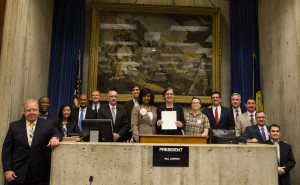
“If you’re organizing, stay strong. You have a movement behind you,” say Ben Brown and Kate Robinson of Mills College. “Adjuncts across the nation are supporting you, and as Mills adjunct faculty members, we can tell you that a victory feels great!”
By

May 20, 2014

Twin Cities Daily Planet: Macalester adjunct faculty fight for fairness

May 20, 2014 | By |

Macalester College contingent faculty are uniting to form a union and make improvements on their campus and beyond. Make sure you check out the Twin Cities Daily Planet story about the movement to raise standards in higher education and share SooJin’s story.

The TCDP writes:

“Pate noted a general trend in the way money is spent at Macalester – fewer dollars going to professors and more going to the administration – as a reason for contingent faculty members to unionize.
“Case in point: his salary. The president makes three quarters of a million dollars. He is one of the highest paid college presidents in the nation,” she said.”

By

April 30, 2014

Maryland Institute College of Art Vote to Join SEIU Local 500

April 30, 2014 | By |

Maryland Institute College of Art (MICA) adjuncts voted overwhelmingly to form their union with SEIU Local 500, joining a national movement of adjunct faculty uniting to raise standards in higher education.The National Labor Relations Board (NLRB) announced the vote count was 163 to 75 on Tuesday, April 29.

Katherine Kavanaugh, an adjunct at MICA, was thrilled at the victory and ready for the next steps. She said, “Today’s victory came after nearly three years of listening to the stories and concerns of many adjuncts. Following several meetings with the administration, it became clear that our voices would not be heard without the strength of an empowered coalition. Now we can begin the work of negotiating with the administration to make MICA a better, stronger institution for all faculty and for the students.”

Today’s vote count at MICA is another inspiring victory in a growing movement of adjuncts who are forming unions to improve conditions and draw attention to higher education’s increasing reliance on contingent faculty. MICA adjuncts are joining George Washington University, American University, Georgetown University and Montgomery College as part of SEIU Local 500.

Adjuncts at more than a dozen schools have or will be voting this semester to join 18,000 adjunct faculty already united in SEIU, including Howard University in Washington, DC, Northeastern and Lesley Universities in Boston, Mills College and San Francisco Art Institute in the Bay Area, Seattle University in Washington State, Marist College in New York State and Hamline University and Macalester College in St. Paul, Minnesota.

By

April 29, 2014

The High Cost of Adjunct Living: St. Louis

April 29, 2014 | By |

Quickly rising tuition has resulted in record levels of student debt, putting higher education out of reach for more and more working families.
At the same time, universities are shifting resources away from instruction. Today, more than two-thirds of all faculty work on a contingent basis, facing low pay and no benefits or job security. Many do not even have access to basic facilities such as office space, making it increasingly difficult for adjuncts to do their best for their students.
Being a university professor, once the quintessential middle-class job, has become a low-wage one.
St. Louis is no exception. Find out how much it takes to afford the basics as an adjunct working in the area, read and share The High Cost of Adjunct Living: St. Louis.

By

April 24, 2014

Macalester, University of St. Thomas and Hamline Contingent Faculty Unite, File for Union Election

April 24, 2014 | By |

Adjunct and contingent faculty at Macalester College, University of St. Thomas and Hamline University in St. Paul announced that they have filed for their union election to join Service Employees International Union (SEIU) Local 284 as part of the national Adjunct Action campaign.

Macalester and Hamline faculty announced the filing at an event with students and Congressman Keith Ellison that capped off a student-led “Contingent Faculty Appreciation Week,” at Macalester Collge that was covered in the Minneapolis Star Tribune, University of Minnesota Daily and Minnesota Public Radio.

Adjunct and contingent faculty spoke of why they are organizing and how a union will give them a voice to improve higher education for both faculty and students.

“We’re coming together because we love our jobs. Right now, contingent faculty are vulnerable because we have no say in determining our contracts,” said SooJin Pate, an adjunct faculty at Macalster. “We believe that having a voice in the decision-making process that affects our lives will not only make us better professors, but will also strengthen the educational mission of the college, making this a better place for our students.”

Macalester students organized multiple events this week to show their support for contingent faculty and spoke at the event Thursday as to why adjunct and contingent faculty forming a union will benefit students on campus.

“The working conditions of adjunct and contingent faculty have a direct impact on my college education - when they need to go between multiple jobs to support themselves, I lose out because the majority of my Macalester experience comes from interacting with professors outside the classroom,” said Leewana Thomas, a Macalester student who joined the faculty at the press conference. “Some of my favorite professors are contingent faculty members, so of course I support their efforts to strengthen Macalester for both students and faculty.”

At the event Congressman Keith Ellison voiced his support for the students and faculty fighting to improve higher education, and shared a public letter he wrote in support of the faculty that stated his hope that Macalester administration would “take the ‘higher ground’ by committing to a position of neutrality and non-interference” with the faculty’s decision to organize.

Adjunct faculty, now the majority of teaching faculty across the country, typically have no job security, no benefits and low pay that forces adjuncts to string together jobs at multiple colleges and universities to make ends meet. At the same time, revenues and tuition have increased steadily over the last two decades while spending on instruction has declined – and it’s adjuncts and their deeply-in-debt students who are suffering as a result.

By

April 16, 2014

Diane Rehm Show Profiles Adjunct Working Conditions, Unions

April 16, 2014 | By |

Adjunct union organizing and working conditions were featured on the Wednesday, April 16th broadcast of the Diane Rehm show. Show guests included Maria Maisto of the New Faculty Majority, the Chronicle of Higher Education’s senior reporter Peter Schmidt, who recently wrote the aptly named article, “Power in Numbers“, about Adjunct Action campaigns in Boston, plus guest administrators from American University (where adjuncts are united in SEIU Local 500) and Kansas State University.

You’ll want to hear and share this important hour-long discussion about how adjunct faculty are working to solve the crisis in higher education.

You can listen by clicking the “Listen” icon at the top of the page: http://thedianerehmshow.org/shows/2014-04-16/growing-reliance-adjunct-professors

By

April 14, 2014

St. Louis Adjunct Faculty Discuss Higher Education, Unions at Symposium

April 14, 2014 | By |

This spring, adjunct faculty across the country are forming unions in order to raise workplace standards and build a national movement in higher education. On Saturday, April 12, 50 faculty from 10 St. Louis area colleges and universities met at the Missouri History Museum to build on the momentum they are creating to win a voice in their profession and to reverse the trend of low pay, few benefits and little job security.

Adjuncts are teaching the majority of classes at many universities, yet we are excluded from any conversation about our own work conditions and how the university should be run, said Jeffrey Maret, an adjunct at Lindenwood University. “We need to get organized to get back in the dialogue and this symposium is a great way to get the conversation started.”

Part-time and non-tenure track faculty are now the majority of faculty at our colleges and universities and their numbers continue to increase. At the same time, revenues and tuition have increased steadily over the last two decades while spending on instruction has declined – and it’s adjuncts and their students who are suffering as a result.

A new study released at Saturday’s meeting explores how difficult it is for an adjunct instructor in St. Louis to afford basic necessities like housing, health care and food.

The report called the High Cost of Adjunct Living: St. Louis, finds that 80 percent or nearly 8,600 faculty members in the St. Louis area were not on the tenure track in 2011. All of the faculty at St. Louis’s for-profit colleges—close to 1,050 faculty employees—do not have access to the tenure system. The median pay per course was $2,700 for master’s level courses at private not-for-profit institutions and $3,000 for doctoral level courses at private not-for-profit institutions. This means an adjunct teaching 12 courses a year—an extraordinary course load—may have an annual income of just $32,400 below the 13 classes a year an instructor must teach to afford a median-priced home and utilities in St. Louis.

Lindenwood University adjunct instructor Andrew Nelson said, “There's real momentum for changing the status quo and that's reflected in the turnout today. Adjuncts in St. Louis are coming together, just like they are in other cities, to talk about how we can raise standards in higher education by uniting for our families and students."

By

April 7, 2014

Boston City Council Unanimously Passes Resolution Supporting Good Jobs for Adjunct Instructors

April 7, 2014 | By |

Adjunct City Council Resolution

Adjunct faculty from Boston University and Northeastern University receive a Boston City Council resolution that calls for fair wages and a free and fair union elections.

On Friday, the Boston City Council unanimously passed a resolution in support of adjunct instructors, calling for colleges and universities in the Boston area to improve pay and benefits for adjunct instructors and to also allow them to unionize without interference.

“The current system for paying adjunct professors is hurting these individuals and their families

but also the classroom experience for our students,” Councilor At-Large Ayanna Pressley said. “With a mounting student loan debt crisis, families want to know what they’re getting for their money. With a compromised teaching force, I believe their dollars are not being maximized.”

The resolution is another way students, full-time professors, community leaders and elected officials are coming together to support Boston-area adjuncts as they help build a nationwide movement to improve standards for the profession by forming unions with SEIU/Adjunct Action.

Judge Isaac Borenstein (retired), Lecturer in Law, Northeastern University School of Law: “Northeastern adjunct faculty are excited about our upcoming election to join our colleagues at Tufts, Lesley and other universities across the country who are winning a voice in their work. I also appreciate that Boston City Council, along with many Northeastern students, alumni and full-time faculty, expect a ‘free and fair election’ where adjuncts alone make the decision, freely and independently, without interference from anyone.”

Higher education is a vital part of the Massachusetts economy and our state’s future. Over half a million students are pursuing a degree at Massachusetts post-secondary institutions. Colleges and universities account for a greater share of employment and payroll in Massachusetts than in almost any other state in the country and post-secondary instructors are among the fastest growing occupations in the state.

By

March 18, 2014

RSVP for the St. Louis Adjunct Symposium on April 12

March 18, 2014 | By |

Saturday, April 12th, adjuncts from across the St. Louis metro area are coming together at the Missouri History Museum to discuss the most pressing issues facing contingent faculty: fair pay, job security, and the lack of voice within the university system.

You’re invited. Click here to RSVP.

The symposium will include panels on the contingent academic workforce and contingent faculty organizing, a discussion of campus organizing, and a number of speakers. It runs from 2 p.m. to 6 p.m.

Adjunct Action is a campaign organized by the Service Employees International Union, and is uniting adjunct professors across St. Louis-area campuses to address the crisis in higher education and the troubling trend toward a marginalized teaching faculty that endangers the profession.

Join us to discuss how we can work together to change those trends and give adjuncts and contingent faculty a voice in the system. Click to RSVP.

If you have any questions, please feel free to contact Stacie Manuel at 773-793-8469.

By

March 11, 2014

Howard University, Maryland Institute College of Art Adjuncts File for Union Elections

March 11, 2014 | By |

On March 7th, adjunct faculty at Howard University in Washington, D.C. and the Maryland Institute College of Art (MICA) in Baltimore filed for a union election and to join the SEIU Local 500 Coalition of Academic Labor. It’s another step forward in the movement to form adjunct faculty unions across America.

The news follows up a huge victory for Lesley University adjuncts in Boston who voted 84 percent to join SEIU/Adjunct Action. In the past two weeks, contingent faculty at Seattle University have also filed for an election.

The MICA campaign marks the first adjunct union election in Baltimore, one of 9 cities where contingent faculty are coming together to form unions with Adjunct Action/SEIU.

Across the country, the message being delivered is clear. Leaving part time faculty without sustainable incomes, benefits or job security runs against the mission of any institution: to serve its students. The status quo is unacceptable and unsustainable.

The next few weeks will be crucial. So we hope you will keep up to date with the latest, events and news here at adjunctaction.org and SEIU Local 500’s website.

Get regular updates on our campaigns
sent directly to your inbox